Indiana's Holding $700M in Unclaimed Money. Here's How I Help Readers Find Theirs.
Indiana's unclaimed property database holds $700M in forgotten money, run by Indiana Attorney General's Office Unclaimed Property Division. Roughly 1 in 7 Americans has something in one of these state databases. I've walked plenty of readers through the search and claim process. This guide is what I tell every one of them.
How to check for unclaimed money in Indiana
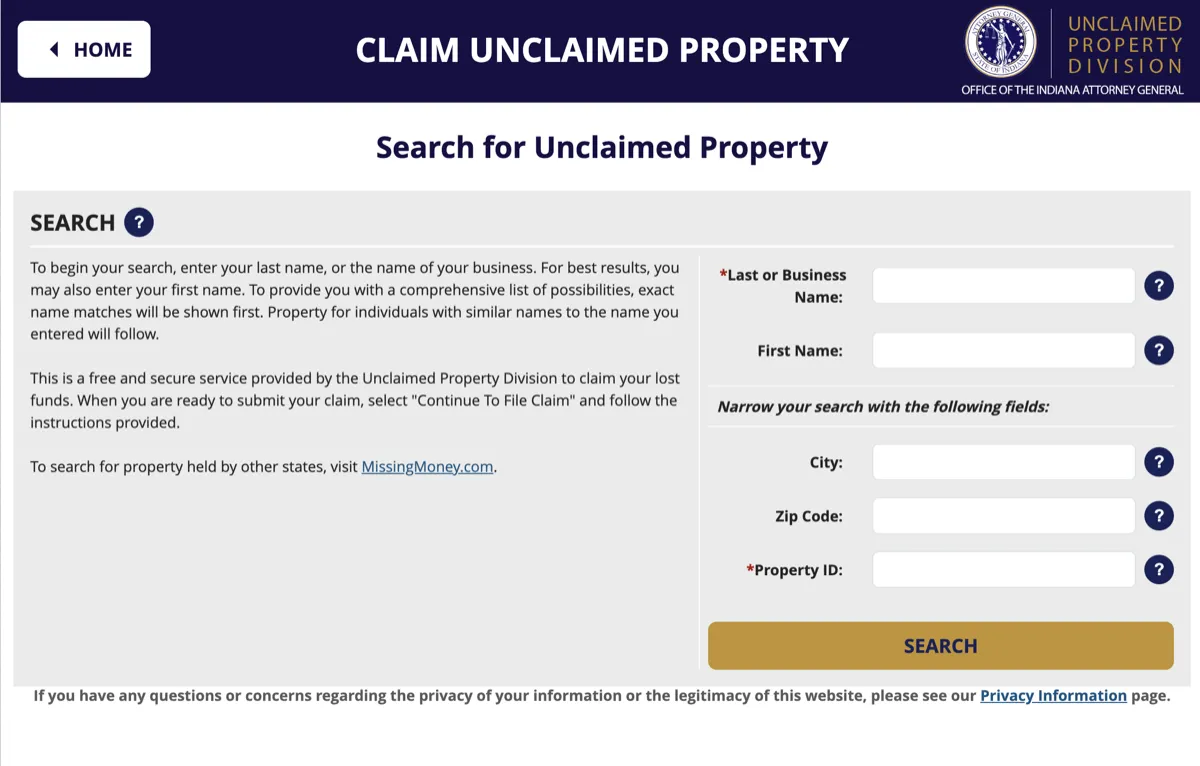
Takes about 30 seconds. The state runs a free search tool at indianaunclaimed.gov. That's the only place you need to look first.
Here's the order I tell readers to run their searches in:
- Full legal name first. Exactly as it appears on your driver's license.
- Drop the middle initial. The database is finicky about middle initials and sometimes hides matches if it doesn't match exactly.
- Try your maiden name. A lot of older records were filed under maiden names that never got updated.
- Try variations. Common nicknames, hyphens removed, accent marks dropped.
Each search takes 10 seconds. Worst case you find nothing. Best case there's $200 sitting under your old apartment address.
How to find unclaimed money in Indiana (and beyond)
The state database covers state-held property only. If you've moved around, lived multiple places, or had a deceased relative in another state, you'll miss money that's sitting elsewhere. Here are the other places I check:
- Other state databases. Every state runs its own. If you've lived outside Indiana, search them all at once on Strata's homepage instead of clicking through each one.
- missingmoney.com. Multi-state aggregator (NAUPA-affiliated). Doesn't include all 50 but covers most.
- IRS unclaimed refunds. About $1.5 billion a year goes unclaimed. Search at irs.gov/refunds.
- Treasury Hunt. Old US savings bonds that matured but were never cashed. treasurydirect.gov.
- FDIC unclaimed funds. Money from failed banks. Still recoverable.
- Pension Benefit Guaranty Corporation. Old employer pensions. Search at pbgc.gov.
- Class action settlements. Money you may be owed from corporate lawsuits (data breaches, price-fixing, defective products). I cover open claims over at fileyourclaim.co.
- Product recalls. If you bought something that got recalled, you're often eligible for a full refund or replacement. Most people throw out the product and forget there was money on the table. I track active recalls (food, drugs, consumer products, medical devices) at fileyourclaim.co/recalls.
- Money-making apps. The other side of the coin. While the state processes your claim (30-90 days), here's the full list of apps I recommend for picking up extra cash. I keep it updated at strata.org/make-money-apps.
If you're going to check more than one or two of these, Strata's homepage runs all of them at once. Saves the back-and-forth.
One more angle worth checking (not unclaimed money, but related): there's a little-known debt relief program available to Indiana residents with $10,000 or more in unsecured debt (credit cards, personal loans, medical bills). It can lower your monthly payments and reduce the total amount you owe. Free analysis, no upfront cost, no obligation. See if you qualify for free →
How to claim unclaimed money in Indiana once you find it
Found a match? Good. Here's what comes next.
- Click "Claim This Property" on the result row.
- Fill out the claim form with your full legal name, current mailing address, and Social Security number. Yes, the state needs the SSN to verify identity. It's not stored long-term.
- Submit proof of identity. A copy of your driver's license or state ID handles most cases. The state may also ask for:
- Old utility bill or lease (if the property was filed under a different address)
- Marriage certificate (if your name has changed since the property was reported)
- Death certificate plus probate documents (claiming on behalf of a deceased relative)
- Wait 30 to 90 days. Most claims process faster, but securities and large inheritances take longer.
- Get your check. Mailed to the address on the claim form.
Watch out for percentage-based "finder" services. Some companies offer to claim unclaimed money on your behalf in exchange for 30-40% of the recovery. The state never takes a cut, so any percentage-based fee is going straight to a middleman. If you find a match, claim it yourself. The state's free database is the same one those services use.
Do I have unclaimed money in Indiana?
Maybe. Here's how to know if it's likely.
You're more likely to have unclaimed Indiana money if any of this applies:
- You closed a Indiana bank account 5+ years ago and forgot a small balance
- You moved out of Indiana without forwarding mail for at least a few months
- You inherited from a Indiana relative (forgotten brokerage accounts and life insurance are the big ones)
- You had a refund check returned undeliverable (utility deposits, security deposits, payroll)
- You worked for a Indiana employer that closed or got acquired
- You held stock in a Indiana company that was bought out, with dividends going to an old address
Indiana's unclaimed property program runs through Attorney General Todd Rokita's office, which is unusual. Most states put it under the Treasurer or a Department of Revenue. Rokita's team returned a record-shattering $82.5 million to Hoosiers in 2025, with another $1 billion still waiting in the database. That single-year return total is one of the highest in state history.
The Indiana wrinkle worth flagging: Rokita's office has been running an eBay auction program for unclaimed safe deposit box contents, which is unusual and surprisingly transparent. If you suspect a relative had a safe deposit box at an Indiana bank that closed, the contents may have already been auctioned, but the cash proceeds remain claimable. The auction listings actually go up publicly on eBay, so you can sometimes identify items.
Beyond that, the Hoosier pattern is fairly typical. Indianapolis, Fort Wayne, Bloomington, and South Bend account for the bulk of claims. IndianaUnclaimed.gov is the portal. The thing I tell Indiana readers specifically is to check for old utility deposits from Duke Energy, NIPSCO, and Vectren. Utility companies are notoriously sloppy about tracking forwarding addresses, and Indiana's regulatory environment lets them escheat dormant balances faster than some peer states. If you've moved within Indiana more than once, you almost certainly have a small utility credit floating around in the database. Five-minute search. Free to claim. No reason not to run it.
What counts as unclaimed property in Indiana
The categories are broader than most people expect:
- Forgotten bank accounts and CDs
- Uncashed paychecks, refund checks, and money orders
- Old security deposits (utility, rental, telephone)
- Stocks, bonds, mutual funds, and dividend checks
- Safe deposit box contents
- Life insurance benefits never paid out
- Court settlements and escrow funds
- Inheritance funds from deceased relatives
The most common single category I see in reader claims is utility deposits. They're small (usually $50–200), but most people forget they ever paid them.
Common questions I get about Indiana unclaimed money
How do I check for unclaimed money in Indiana?
How do I claim it once I find a match?
Do I actually have unclaimed money in Indiana?
Can I claim for a deceased Indiana relative?
Is there a fee to claim unclaimed money in Indiana?
What happens to safe deposit box contents after 7 years?
What if I moved out of Indiana?
Nearby States to Check
Lived in or near Indiana? Most readers find money in 2-3 states. Check the unclaimed property database for each: